From an investor’s perspective, real estate crowdfunding is an “investment destination,” but from an operator’s perspective, it is “one way to raise money.” Understanding the operator’s circumstances will change how you read a fund’s page.
It starts with the “property”
The job of a real estate company is to acquire properties, rent them out, or increase their value and sell them. Funds for this are usually covered by the company’s own capital and bank loans. While there are other methods such as corporate bonds or private placement funds, real estate crowdfunding has been added as a way to raise small amounts from individual investors.
For many funds, the sequence is “there is a property we want to acquire first, and we raise part of the funds through crowdfunding.” Sometimes, properties that have already been acquired are turned into funds later.
Differences between bank loans and crowdfunding
It is not necessarily a choice between bank loans or crowdfunding. Some funds combine both.
Reasons why operators use crowdfunding
Crowdfunding often pays higher distributions to investors than bank interest rates, so it can be a more expensive way for operators to raise money. Even so, it is used mainly for the following reasons:
-
Efficient use of own capital: Able to work on multiple properties with less own capital
-
Increasing sources of funding: Not relying solely on banks, allowing loan capacity to be reserved for other projects
-
Less likely to miss business opportunities: Able to consider ways to raise funds even for projects that do not meet bank loan conditions or for projects to be sold in the short term
-
Creating touchpoints with investors: Increasing company awareness and the number of members who invest continuously
For example, suppose an operator has 100 million yen in own capital and wants to acquire a 100 million yen property. If they cover the entire amount with their own capital, their funds will be exhausted with one property. If the operator contributes 20% and raises the remaining 80% from investors, they can work on 5 properties with the same amount of own capital.

However, a fundraising campaign is not guaranteed to succeed, and depending on the campaign period and the conditions for success, it may take longer than a bank loan.
How do operators earn revenue?
Operators use the money they raise to acquire real estate and generate revenue through leasing or sales.
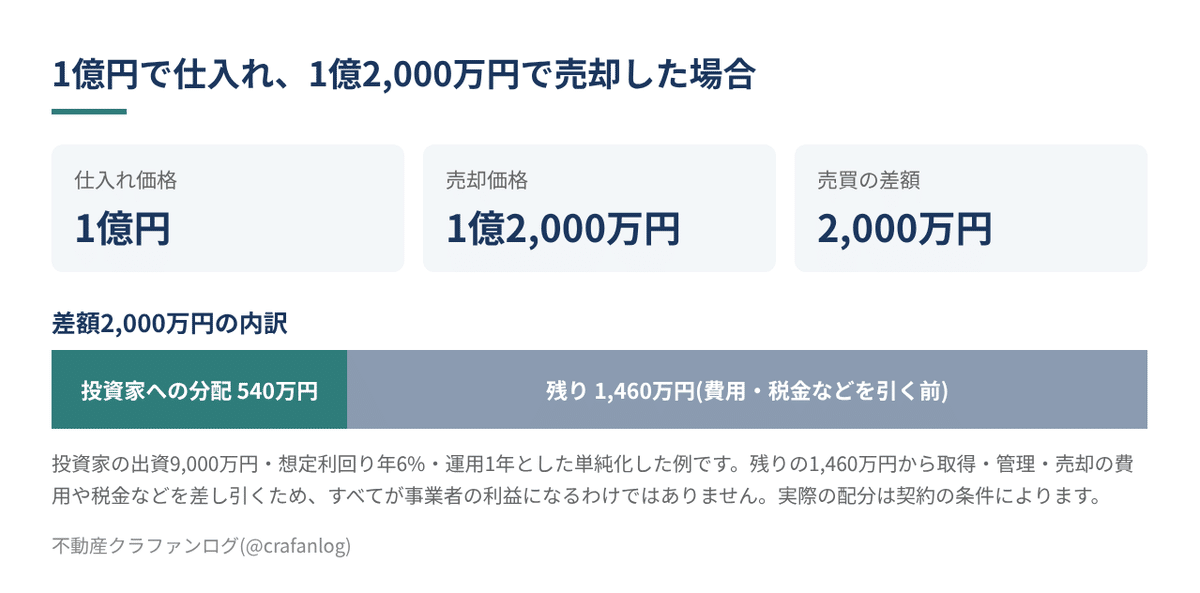
For example, if a property acquired for 100 million yen is sold for 120 million yen, the difference from the sale is 20 million yen. If 90 million yen invested by investors is distributed at an annual rate of 6% for one year, that is 5.4 million yen, leaving 14.6 million yen. However, this remainder is the amount before deducting acquisition, management, and sales expenses, as well as taxes, so not all of it becomes the operator’s profit.

Operator income mainly includes the following:
-
Operation and management fees: Fees for fund formation, operation, real estate management, etc.
-
Distribution to subordinated investment: Profit on the portion invested by the operator themselves
-
Distribution of remaining profits: Profits received by the operator according to the contract after distributions to investors and other payments have been made.
Which income is received by whom and in what amount depends on the fund’s structure and the terms of the contract. Operators do not profit from the raised funds themselves, but rather earn revenue through real estate management, sales, and fund administration.
The “Priority/Subordinated” Structure
Many funds use a structure where investor contributions are treated as “priority contributions” and operator contributions as “subordinated contributions” to share profits and losses.
For example, in a 100 million yen fund where investors contribute 90 million yen and the operator contributes 10 million yen, if a loss occurs, it is generally borne by the operator’s subordinated contribution first. In this example, if the loss is 10 million yen or less, the principal of the priority contributions remains unaffected.

However, the priority/subordinated structure is not a guarantee of the investor’s principal by the operator. If losses exceed the subordinated contribution, the investor’s principal will also decrease. Furthermore, if the fund also uses bank loans, repayment of the loans generally takes precedence over the redemption of capital contributions. You need to check not only the ratio of subordinated contributions but also the presence of any loans.
For funds that use a priority/subordinated structure, the ratio of subordinated contributions is stated on the page or in the pre-contract document. A detailed explanation of how to read this will be provided in “How to Read a Fund Part 1: What is a Subordinated Contribution?”
Perspectives Investors Should Keep in Mind
For an operator, crowdfunding is one way to raise funds to advance their business. The fact that they are using crowdfunding alone does not indicate whether the operator or the property is good or bad.
When looking at a fund, it becomes easier to understand the structure if you check the following three points separately:
-
Source of distributions: Are distributions made from rental income, or from profits earned through sales?
-
How principal is returned: How will the capital contribution be returned when the operation ends, such as through sales proceeds or refinancing funds?
-
Who to sell to: If selling, what kind of buyer is anticipated?
In the upcoming “Real Estate Crowdfunding for Beginners Part 4: Types of Funds,” we will explain how to distinguish these.