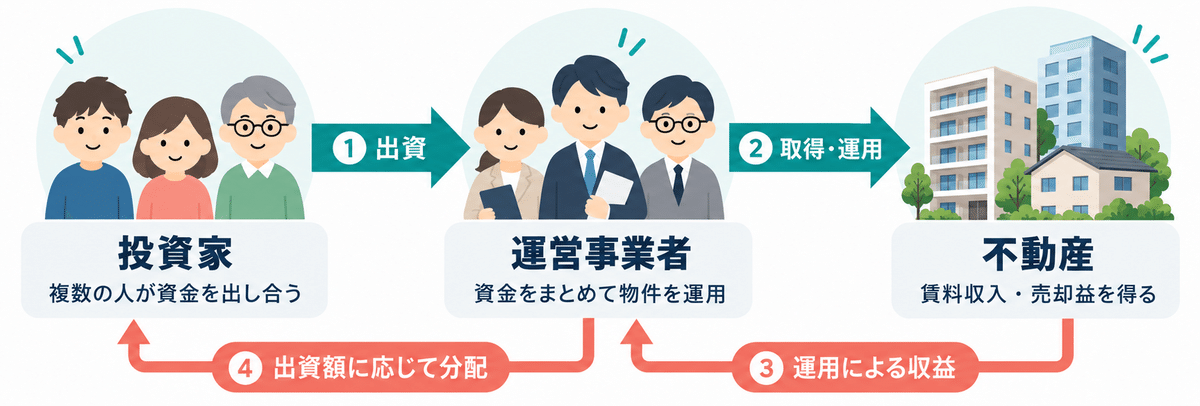
When you hear “real estate crowdfunding with a 5% yield,” don’t you feel tempted to jump right in?
I felt the same way at first. Some funds let you start with as little as 10,000 yen, and with an estimated yield of 5% over a 12-month operating period, the estimated distribution comes to roughly 10,000 yen × 5% = about 500 yen. Looking just at the numbers, it’s straightforward and accessible.
However, from my perspective—regularly inspecting vacated apartments on-site for restoration work—there are three points that give me pause. I’ve broken down what lies behind those yield figures based on real on-site experience.
*This is not investment solicitation or personalized advice. It is general information and a record of my own personal learning.
-
Look at Yield in Terms of “Take-Home” Returns
In real estate crowdfunding, yields are presented for each fund as an “estimated yield.” However, fixing up rooms on-site makes you realize that a property’s profitability can shift dramatically with just a single repair cost.
For example, just re-wallpapering a 6-tatami room costs roughly 30,000 yen as a rule of thumb. If an air conditioner breaks down, there is replacement cost, and replacing a water heater amounts to an even larger expense. The older a property is, the more likely these expenses are to arise.
In the case of crowdfunding, repairs are basically borne by the operating company, and it is rarely structured so that investors pay out of pocket directly. However, for properties where repairs pile up, it becomes difficult for the original profit plan to proceed as expected in the first place.
That is why, when looking at a fund’s yield, instead of just staring at the numbers, I try to picture things like, “How old is this building, and what kinds of repairs might come up going forward?” A surface 5% does not automatically translate into a net 5% in your pocket. I believe it’s essential to evaluate yield based on “how much is actually left over.”
-
No Principal Guarantee, and Mid-Term Cancellations Are Not Allowed
The second point concerns moving money in and out.
Real estate crowdfunding is not a bank deposit. The principal is not guaranteed, and if management does not go well, there is a chance the principal could be reduced. The “estimated yield” is strictly an estimate, not a guaranteed figure.
Furthermore, you basically cannot cancel mid-term during the operating period. Many funds have an operating period of about 6 to 24 months, and your capital remains locked up during that time.
If an office worker like me were to start, I believe the prerequisite should be separating this from living expenses and emergency funds, treating it as “money you won’t mind leaving untouched for a while.” Even though you can start from 10,000 yen, I make sure to check “how long it will be locked up” before deciding how much money to put in.
-
How to Assess the Reliability of the Operating Company
The third point is whom you are entrusting your money to.
I feel that with crowdfunding, success or failure depends heavily on the attitude and posture of the operating company, even more so than the property itself. When reviewing fund information, here are the three points I check:
• Does it have a track record of past fund redemptions? (A record of finishing the operational period and properly returning the capital)
• To what extent is property information disclosed? (Location, building age, expected rent, etc.)
• Has there been any history of delayed distributions or extensions of the operating period?
When a fund features flashy property photos and high estimated yields but lacks a solid track record and detailed disclosures, I take a step back. Conversely, even if an operating company appears modest, having a steady accumulation of redemption track records provides much greater peace of mind from an on-site perspective.
Three Checks to Confirm Before You Start
To sum up, these are the three checks I personally run.
-
Evaluate yields based on “how much remains.” Check whether the property’s age and condition are likely to incur repair costs.
-
Understand that principal is not guaranteed and mid-term cancellations are not allowed, and only invest funds you will not need for a while.
-
Look at the operating company’s redemption track record and the level of detail in its information disclosure.
I think real estate crowdfunding is an interesting gateway that lets you experience how real estate investment works starting from small amounts. However, seeing repair costs firsthand on-site, I feel that being able to picture the “reality of the property” behind the numbers is the deciding factor in staying engaged for the long haul.
When choosing a crowdfunding fund, what do you look at first?
Every day on Threads, I post brief study updates on real estate investment and the Real Estate Transaction Agent (Takken) exam from the on-site perspective of property restoration. Feel free to check them out as well.