You can start with as little as 10,000 yen, and the management is handled for you.
Because of this convenience, real estate crowdfunding is gaining attention🏠
In this article,
I, a holder of a Level 2 Financial Planner certification who is also an active investor,
will explain the basic mechanics, pros, and cons in an easy-to-understand way.
I hope this serves as a helpful reference
for those who are thinking about getting started.😊
What is Real Estate Crowdfunding? [A Brief Overview]
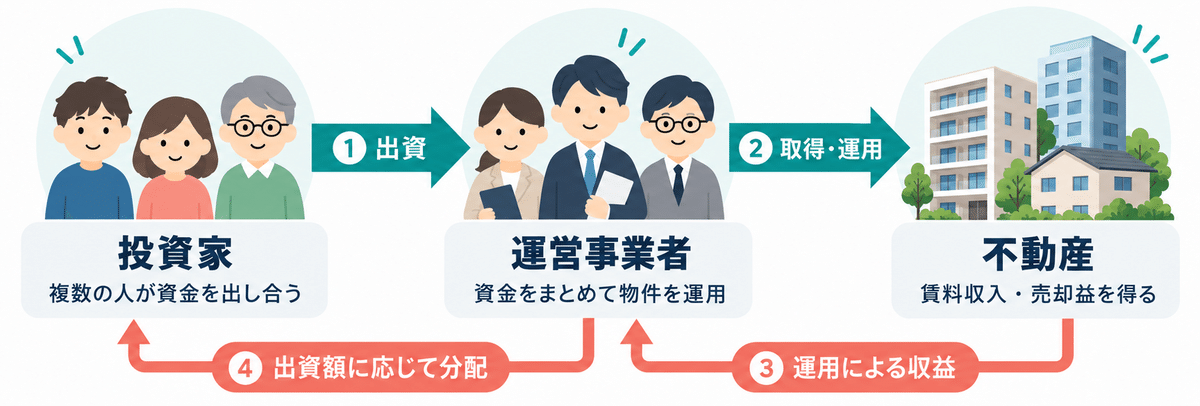
Real estate crowdfunding is a system where
everyone pools small amounts of money together to
invest in real estate.
For example, suppose you invest 10,000 yen.
The operator uses the money collected from multiple investors
to purchase and manage properties like apartment buildings.
A portion of the rental income or capital gains earned from that
is returned to you as a distribution!
🏢What kind of real estate do you invest in?
In addition to apartments and condominiums,
there are hotels, commercial facilities, offices, and more.
You can invest small amounts in properties that are otherwise difficult for individuals to access.
📊The market is expanding
The annual investment amount has grown approximately 139 times in six years,
exceeding 170 billion yen in fiscal year 2024 (*Ministry of Land, Infrastructure, Transport and Tourism).
As the number of services increases,
it is becoming easier to choose an investment destination that suits you.
👍There are mechanisms to mitigate risk
Some services adopt a
priority-subordinate structure to
limit losses for investors.
The operator also invests their own money,
and if a loss occurs, it is borne by the operator’s investment first.
For example, if the operator invests 30%,
as long as the loss stays within 30%, the investor’s principal will not decrease.
Benefits of Real Estate Crowdfunding
There are four main reasons why real estate crowdfunding is chosen.
✅High yields
The expected yield is
centered around projects with an annual return of about 3–8%.
For example, if you invest 100,000 yen at a 5% annual rate for one year,
the distribution will be 5,000 yen (before tax).
You can expect higher returns than leaving it in a savings account.
✅ Invest easily starting from 10,000 yen
There are many services that allow you to invest from 10,000 yen per unit.
Even if you don’t have a large amount of capital,
the appeal is that you can try it with an amount you are comfortable with.
✅ No hassle with management
Property management and tenant relations are
all left to the operator.
Once you invest, you can just leave it alone
and just wait for the distribution 💸
✅ Transactions can be completed easily on your smartphone
Most services allow you to complete everything from member registration to investment
on your smartphone.
There is no need to go to a counter or mail documents,
so you can start in your spare time 📱
Disadvantages of real estate crowdfunding
There are also 3 points you should know before starting ⚠️
✅ Principal is not guaranteed
Just like other investments such as stocks,
there is a possibility of loss (the principal may decrease).
That is why it is important to look at the priority/subordination ratio and track record,
and choose your service carefully.
✅ You may not be able to cancel midway
In principle, many projects cannot be cashed out during the investment period.
The basic rule is to invest money that you do not plan to use.
✅ It can be difficult to invest in popular services
Popular projects can fill up within minutes of opening.
If you complete your member registration early for services you are interested in,
you can act quickly when recruitment begins.
Points for choosing real estate crowdfunding [Are there over 100 companies!?]
There are now over 120 real estate crowdfunding services.
Don’t decide just because the “yield is high”;
the following six points will help you avoid failure.
1️⃣ When will the money be returned? (Investment period)
This varies by project, ranging from a few months to several years.
When investing for the first time,
choosing a short-term project of about 3 to 6 months is safer.
2️⃣ How much can you invest? (Minimum investment amount)
Some services start from 10,000 yen,
while others start from 100,000 yen.
It is easier to start with services where you can try with a small amount.
3️⃣ What kind of properties are you investing in? (Investment target)
Residential properties like apartments
have rents that are less likely to drop even if the economy worsens,
making them properties with stable returns.
While hotels and commercial facilities offer higher yields,
their earnings are more easily affected by the economy and the number of tourists.
If you prioritize stability, it is easier to start with residential projects.
4️⃣ Is there a provision for losses? (Ratio of priority-subordination structure)
The project page will state “Subordinated investment ◯%”.
Some services are around 5%, while others exceed 30%;
the higher this number, the less likely your principal will decrease even if property prices fall.
5️⃣ What is the track record? (Operational performance)
Check if there have been
any losses of principal or delays in distributions in the past.
In addition to the official website,
search online using the service name and operating company name,
It is also reassuring to check if there are any reports of trouble or information regarding administrative actions!
6️⃣ Is the information properly disclosed? (Information Disclosure)
Check if the location of the property and the basis for the yield are stated.
It is safer to avoid projects with little explanation.
Summary
Real estate crowdfunding is an investment that you can start from 10,000 yen and leave the management to professionals.
When choosing a service, the key is to check not only the yield but also the investment period, the ratio of the priority-subordinate structure, and past performance🙌
I am also currently using it as one of my options for asset building while actually investing in several services.
I will continue to share recommended services and my impressions from actually using them😊